Partnership Pantry
Mondelēz brings joy to billions through its brands.
IBM builds the global delivery infrastructure that powers that mission — across every market, every system, and every transformation ahead.
The IBM–Mondelēz relationship didn’t begin with a contract. It began with a shared conviction: that borderless operations are the foundation of a truly global consumer business. Since 2012, IBM has been the strategic partner Mondelēz has turned to when the transformation work is hardest.
From harmonizing ERP across 22 Central and Eastern European markets under the Kraft Catalyst program, to designing and operating the global Application Delivery Factory, to collaborating on blockchain-enabled food safety — IBM has been present at every inflection point in Mondelēz’s technology journey.
That track record isn’t incidental. It reflects IBM’s unique position at the intersection of CPG industry depth, SAP expertise, and the cultural discipline needed to operate at Mondelēz’s scale — a combination no late entrant can replicate.
IBM’s approach to Mondelēz isn’t a service catalog — it’s an integrated delivery framework where each dimension reinforces the others. Select any pillar to see what IBM has built and delivered.

Every engagement has built institutional knowledge that makes the next one faster, deeper, and more impactful. That compounding effect is IBM’s most durable advantage in this relationship.

Mondelēz’s $1.2 billion transformation isn’t a disruption to the partnership — it’s the clearest signal yet of what IBM’s work has made possible. A company that spent years stabilizing its ERP foundation is now ready to lead a widescale modernization.
As Mondelēz executes its region-by-region S/4HANA migration through 2028, the work IBM pioneered — harmonized processes, factory discipline, cultural change management — provides the baseline from which that migration can run cleanly and confidently.
IBM’s position in this next chapter is defined by the institutional knowledge no late entrant can replicate: the Mondelēz architecture landscape, the template governance, the IS leadership relationships, and the proven ability to lead multi-partner programs at this scale.
From global CPG programs to AI-embedded ERP transformations — a curated selection of IBM case studies that mirror the scope, complexity, and ambition of what Mondelēz International requires.
Migrated SAP Business Warehouse to SAP HANA, dramatically cutting nightly batch times as data volumes scaled across a global food and beverage portfolio.
View case study
Colombian multi-brand food producer used IBM Rapid Move to migrate to SAP S/4HANA — enabling better retail analytics and improved product-mix visibility across its full brand portfolio.
View case study
PepsiCo’s $18B snack division digitally empowered frontline employees — improving customer service execution and brand portfolio management at national scale.
View case study
World’s leading glass packaging manufacturer for food and beverage brands migrated its SAP data to IBM Db2 — cutting costs and improving operational performance across global operations.
View case study
Deployed SAP S/4HANA across global manufacturing operations using a standardized template — supporting AUDI’s transition to electric mobility without disrupting a complex, multi-market ERP estate.
View case study
Migrated to SAP S/4HANA across a distributed retail network — standardizing processes and integrating systems to protect margins at scale across a multi-entity enterprise.
View case study
Portuguese energy company executed a full SAP S/4HANA transformation on IBM Cloud — modernizing its integrated platform across multiple business units with zero operational disruption.
View case study
On-premises and cloud SAP S/4HANA deployment with a full HANA migration — opening new market opportunities and establishing a scalable platform for future growth across Latin America.
View case study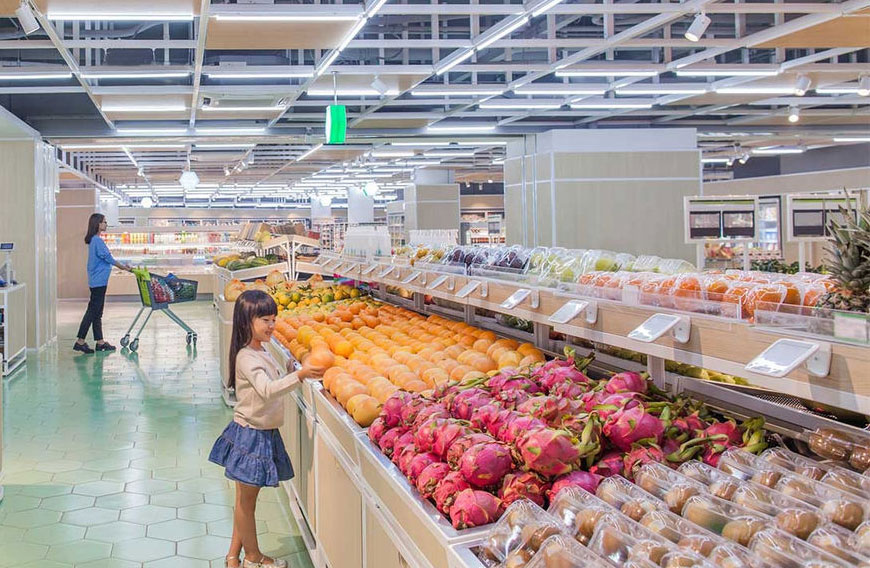
Built a centralized food traceability platform on IBM Food Trust blockchain — enabling farm-to-shelf provenance tracking with contamination isolation and recall capability in near real time.
View case study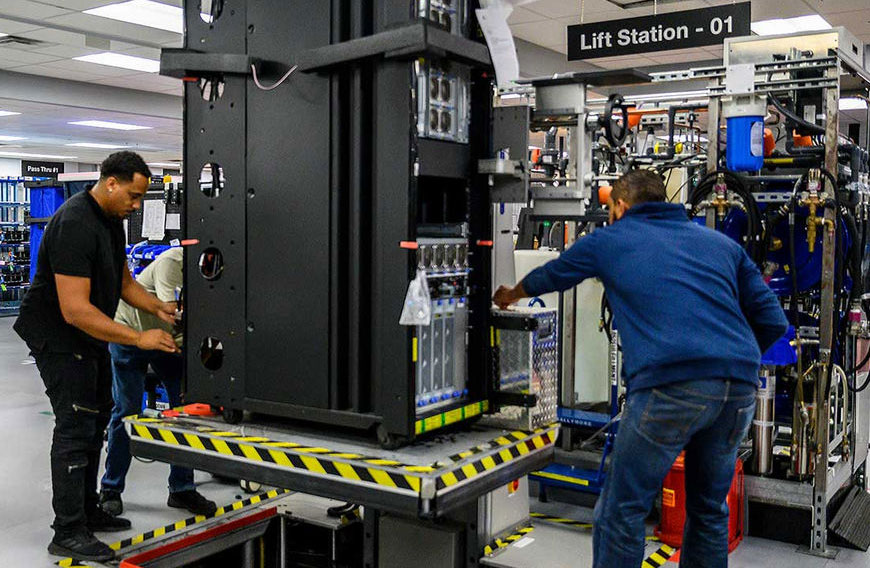
IBM built its own first cognitive supply chain using blockchain, track-and-trace, IoT, and AI — achieving 100% order fulfillment even during COVID and offering the model as a client blueprint.
View case study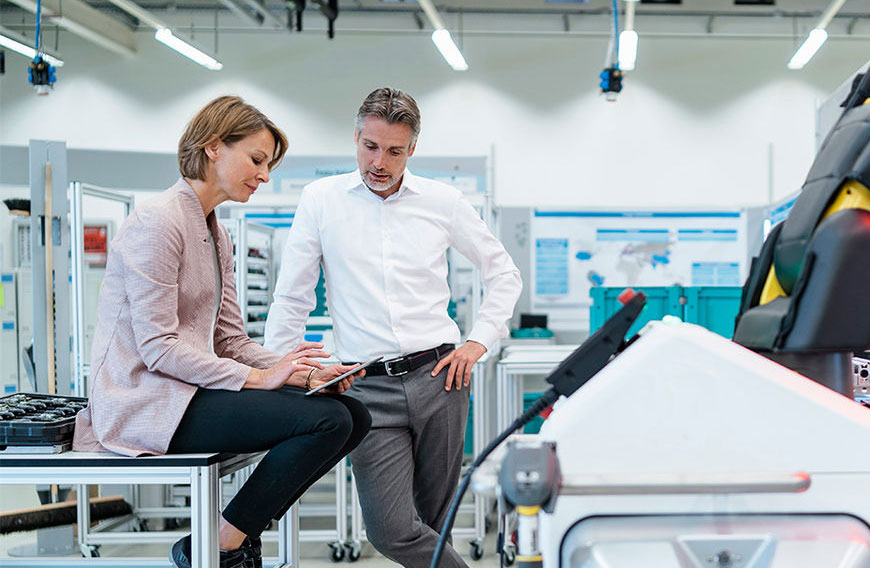
Demonstrates how AI, blockchain, IoT, and automation weave into end-to-end supply chain, finance, and procurement workflows — a reference architecture for the intelligent enterprise.
View case study
Rome’s wholesale food market deployed IBM Blockchain Platform to trace provenance and ensure food safety across its distribution network — making unsafe products identifiable and removable in minutes.
View case study
Full data center exit to AWS with hypercare support and structured handover — reducing costs while maintaining service agility and establishing a cloud-first operating baseline across Europe.
View case study
Enterprise infrastructure transition managed with IBM Turbonomic and Instana — ensuring service continuity, ITIL alignment, and uptime during a complex operational handover.
View case study
Used IBM Instana to maintain uptime and observability across a cloud migration to AWS — enabling digital transformation at scale without service disruption to a 24/7 mobility platform.
View case study
IBM managed the transition to SAP S/4HANA in the cloud with zero disruption — governance controls and managed services kept global chemical manufacturing operations running throughout.
View case study
Deployed IBM watsonx.ai LLMs to generate board-ready business insights from enterprise data — a reusable pattern for AI-powered decision support inside any ERP landscape.
View case study
Built a watsonx.ai-powered solution letting enterprise users query structured operational and ERP-adjacent data in natural language — delivering reliable business insights at scale.
View case study
Deployed IBM watsonx Assistant with LLM capabilities to eliminate customer wait times entirely — demonstrating generative AI automation at enterprise scale across a major utility operation.
View case study
Modernized IT operations and finance functions using watsonx.ai and watsonx Orchestrate — embedding generative AI and intelligent automation directly into enterprise workflows at scale.
View case study
During the IBM India site visit, your team used a custom-built design thinking app to map personas, chart user journeys, and surface transformation opportunities in real time. That tool lives here — rebuilt for the web so you can return to those insights at any point.
Seven moments — from picking a persona, through the empathy map and journey, to the opportunity matrix and a shareable session summary.
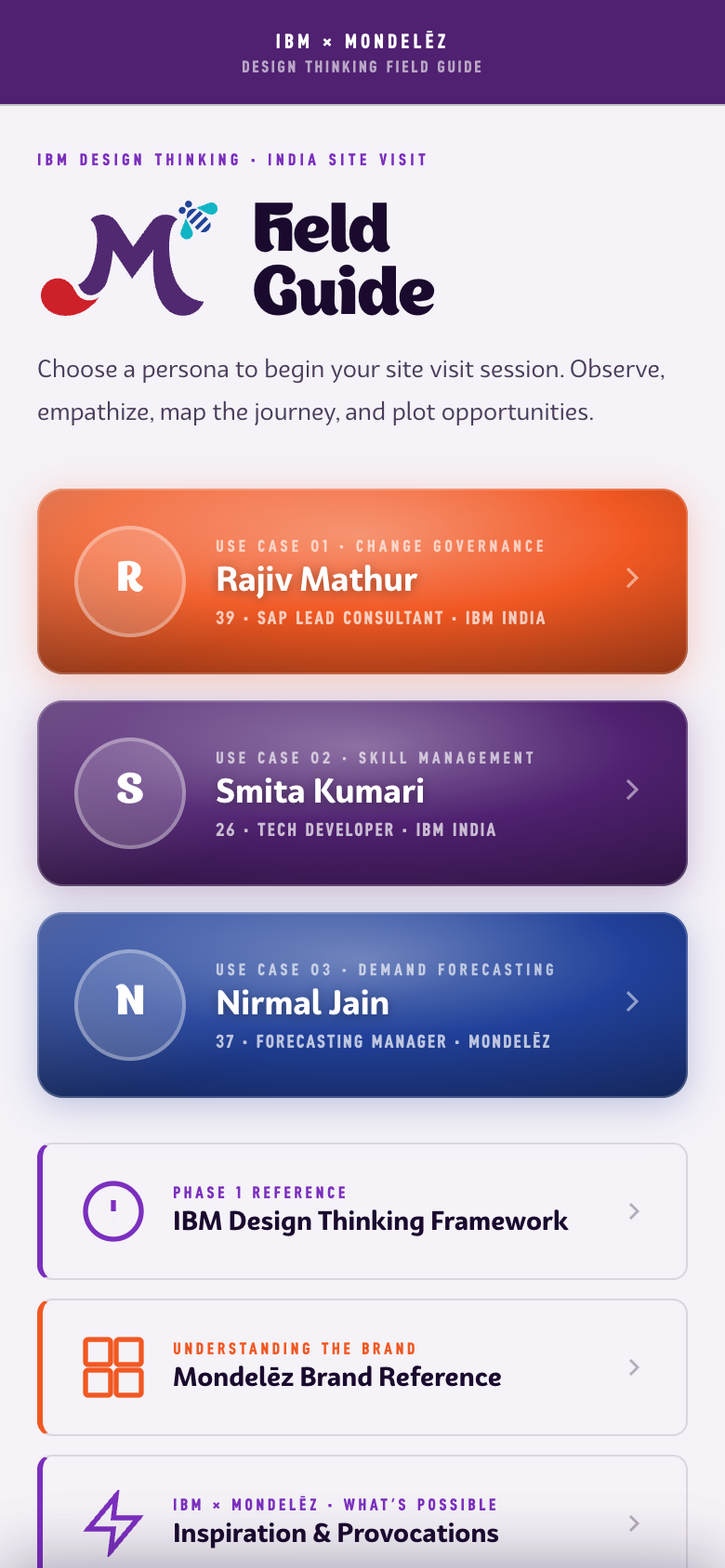
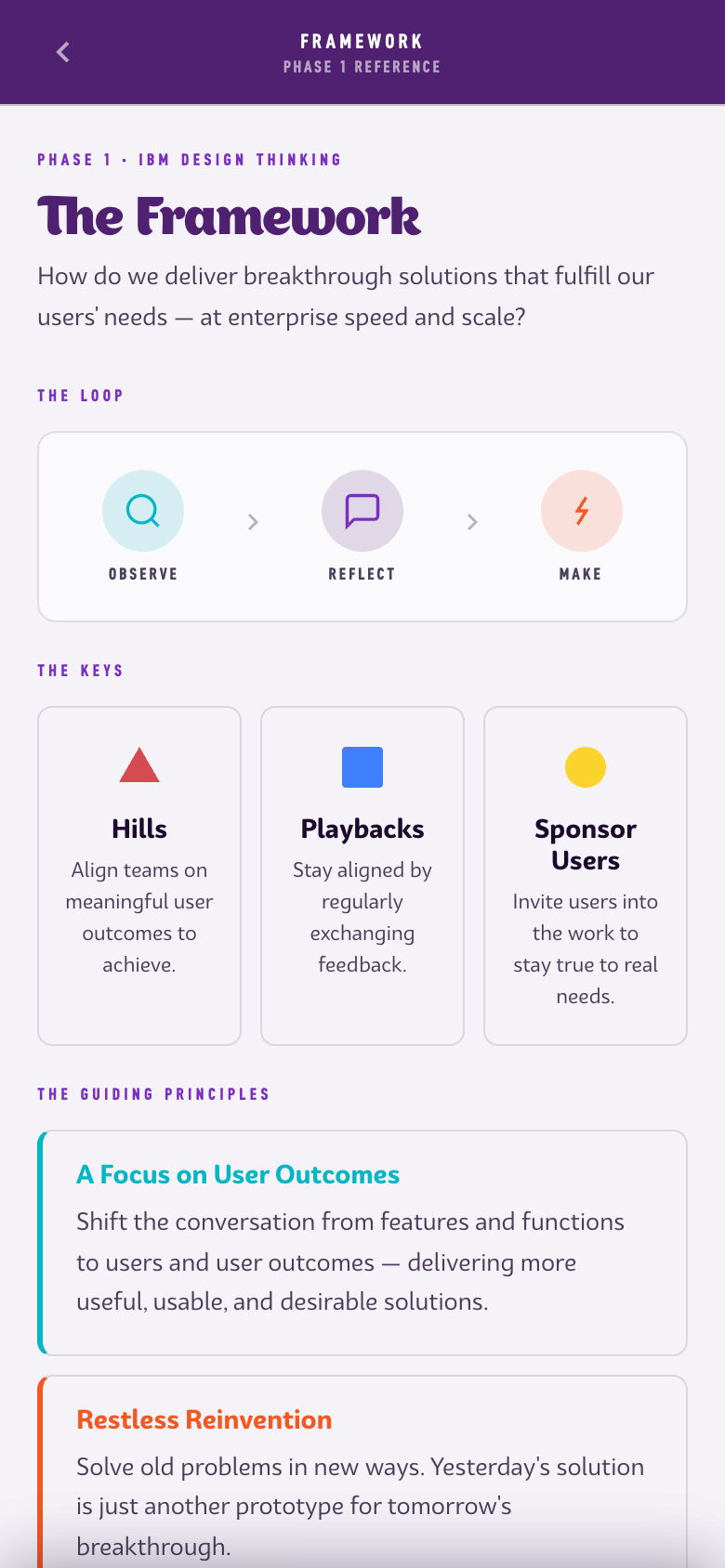
The home screen is the entry point — three real practitioners across the IBM × Mondelēz engagement, each navigating a distinct work reality. Tap a persona to begin, or open the framework reference to ground the room before you start.
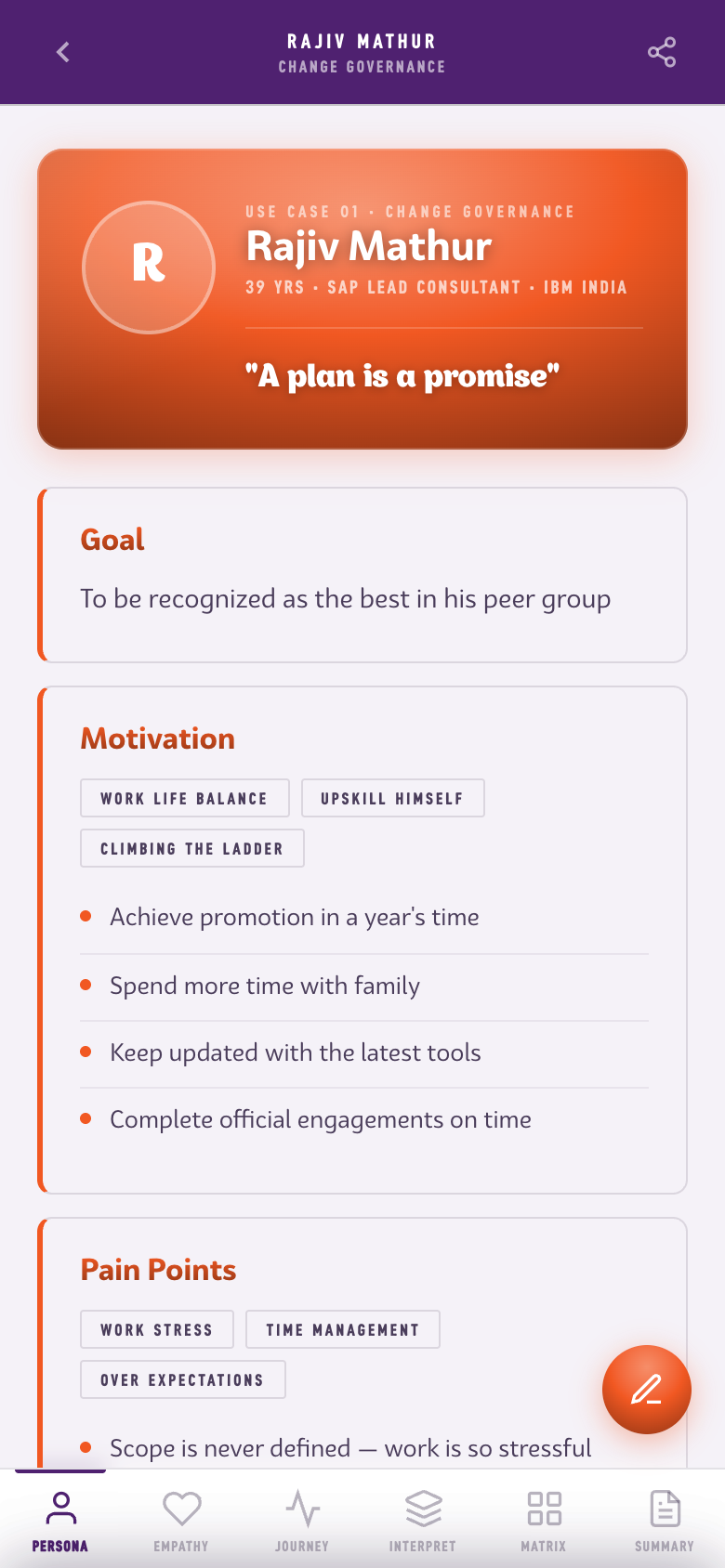
Rajiv Mathur — 39, SAP Lead Consultant, IBM India. Goal, motivations, pain points, all on one canvas. Every detail came from the live session: what he says, what stresses him, what he wants the next year to look like. The same template carries Smita's ambition and Nirmal's forecasting load.
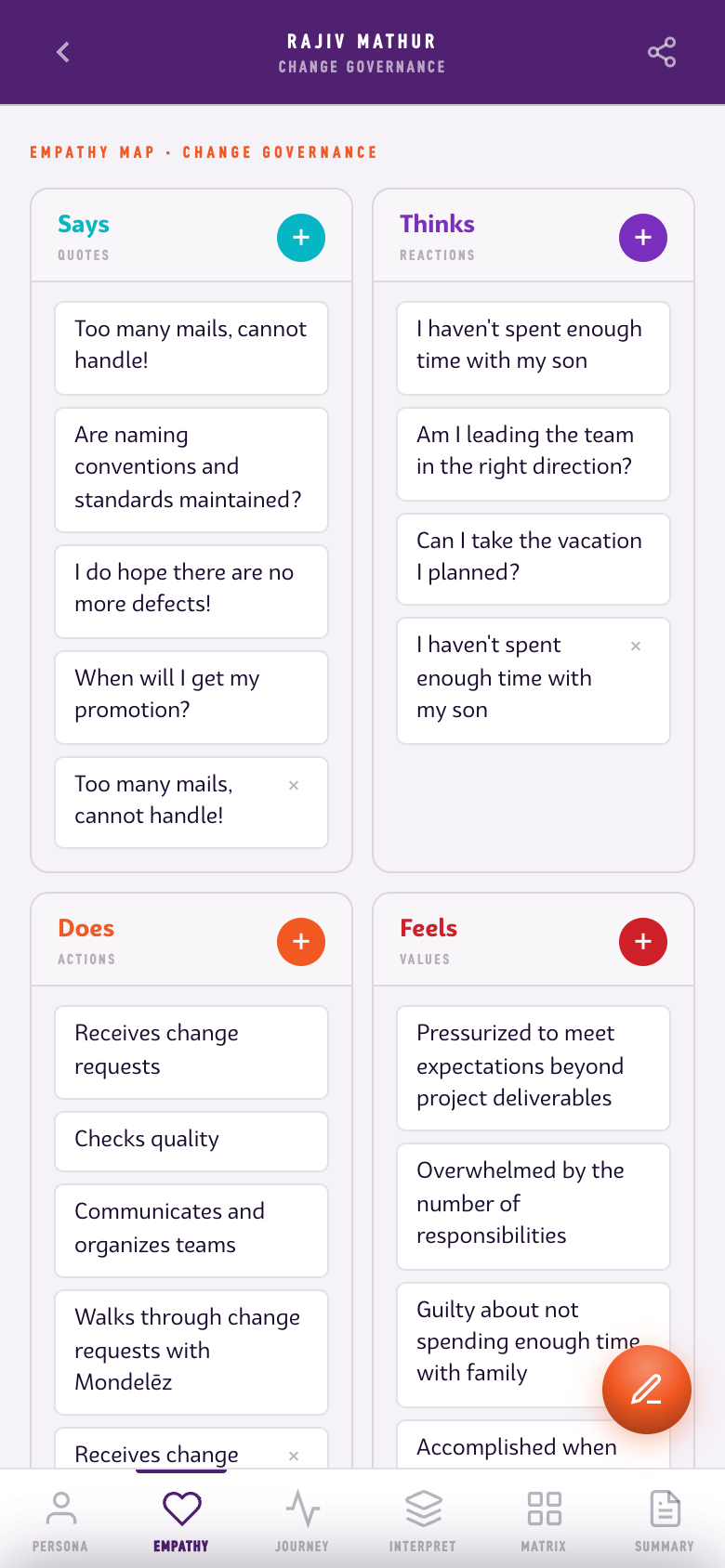
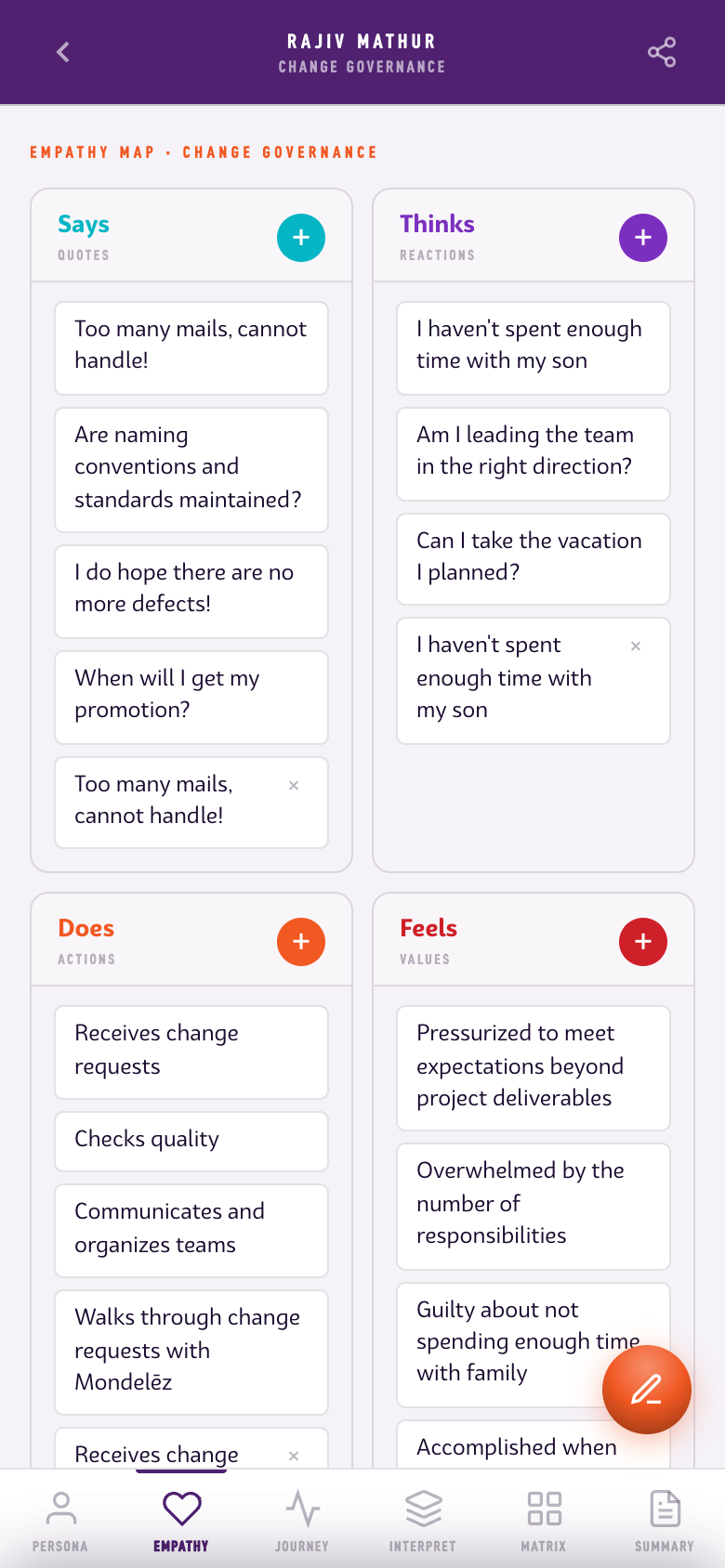
The empathy map starts empty and fills in as the room talks. Tap the orange + on any quadrant to add an observation. By the end of the session, "Too many mails, cannot handle!" sits next to "Pressurized beyond project deliverables" — and the team is looking at the same picture.
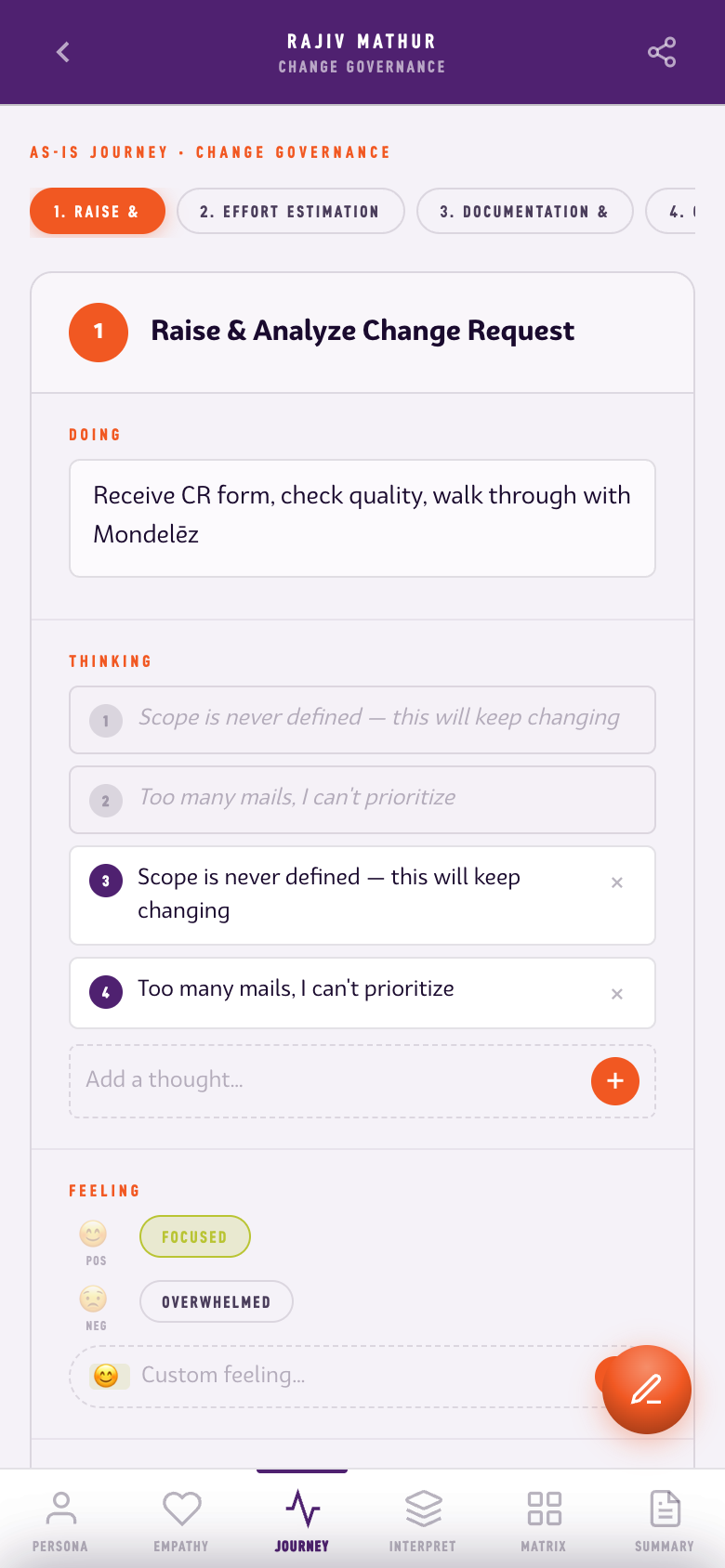
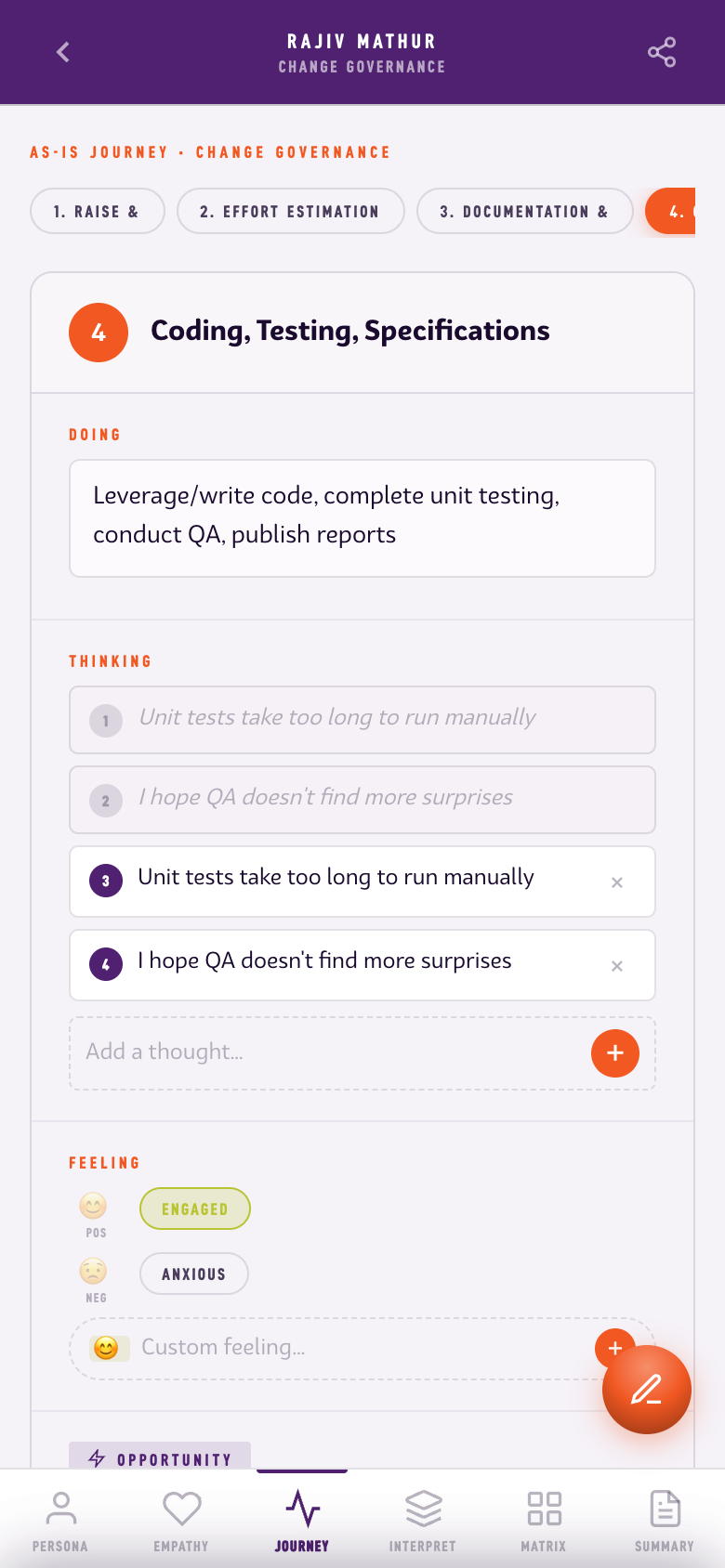
Each persona's day is broken into stages — for Rajiv, five of them, from raising a change request to deployment. Each stage captures what they're doing, what they're thinking, how they feel, and the IBM opportunity hiding inside the friction. "Real-time testing feedback would cut this cycle in half" lands here, in step four, and it doesn't get lost.
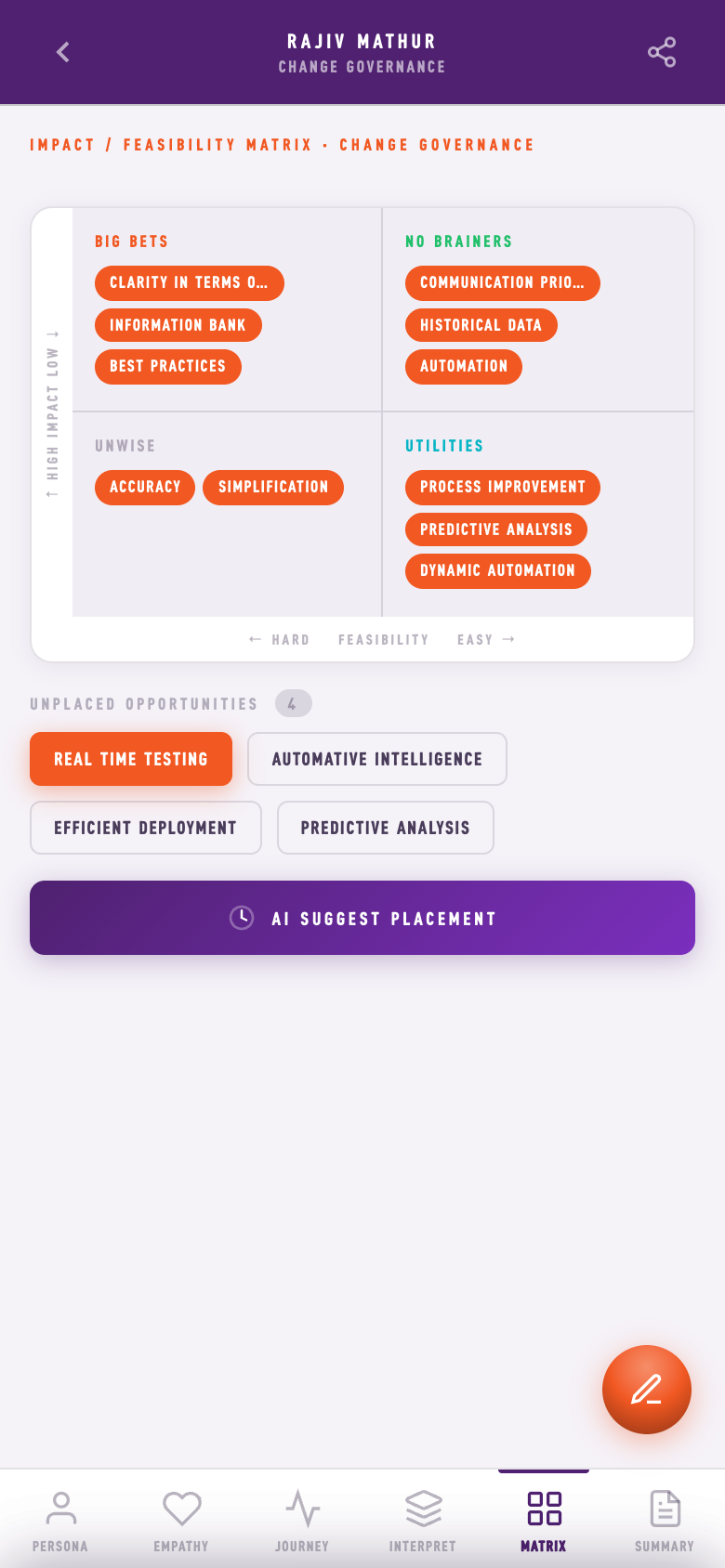
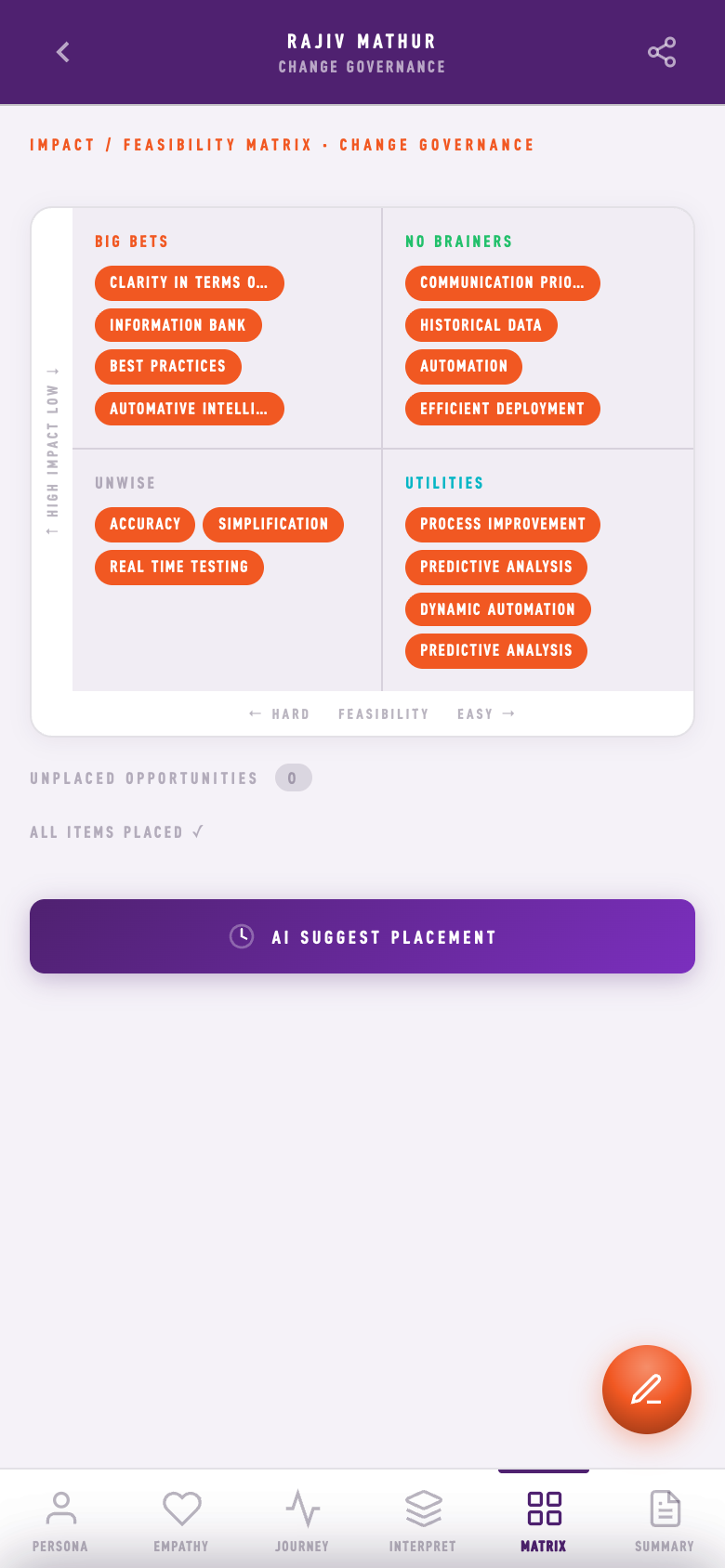
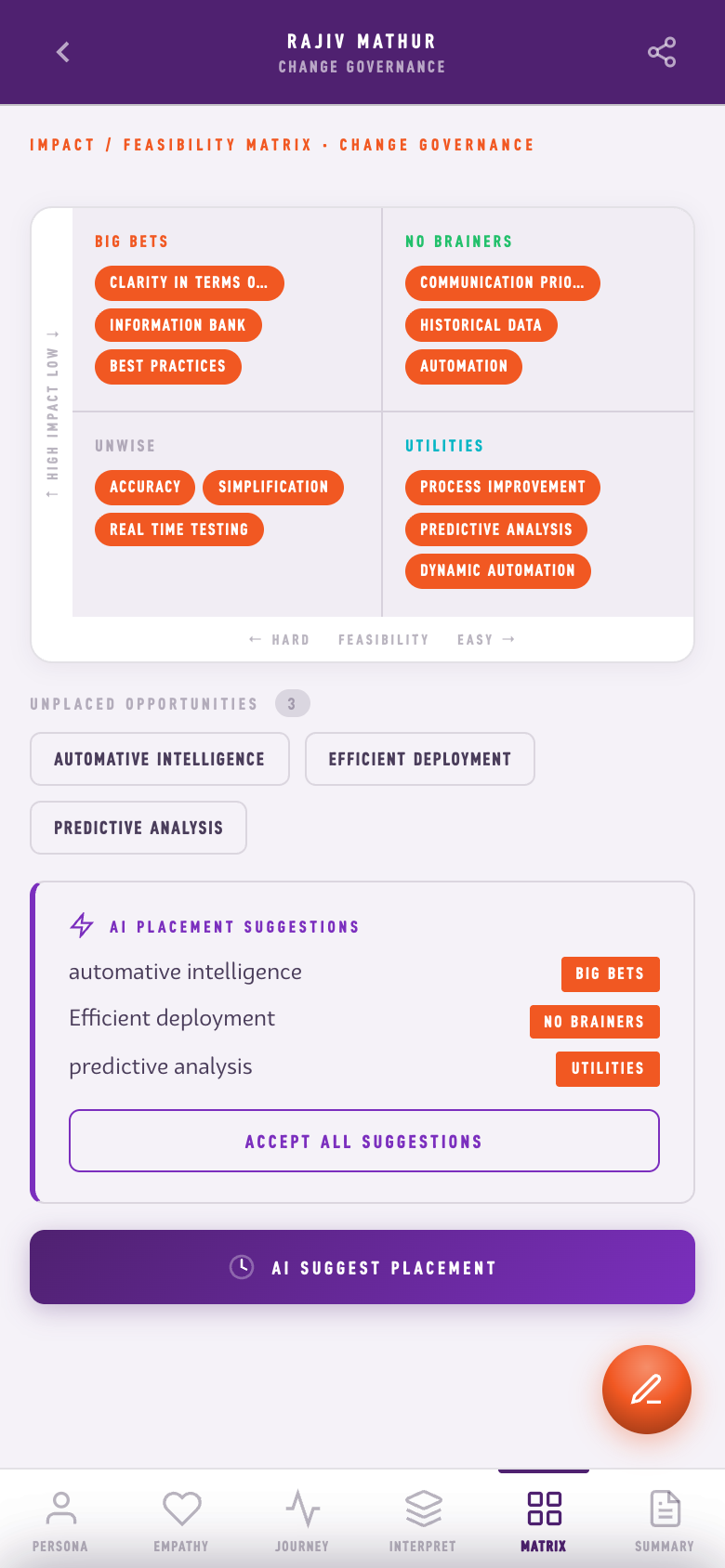
Every opportunity surfaced in the journey lands in a tray, ready to plot. Drag onto the impact-vs-effort grid: Big Bets top-left, No Brainers top-right, Utilities bottom-right, Unwise bottom-left. When the room stalls, "Suggest with AI" plots the rest — and the room argues with that, which is the point.
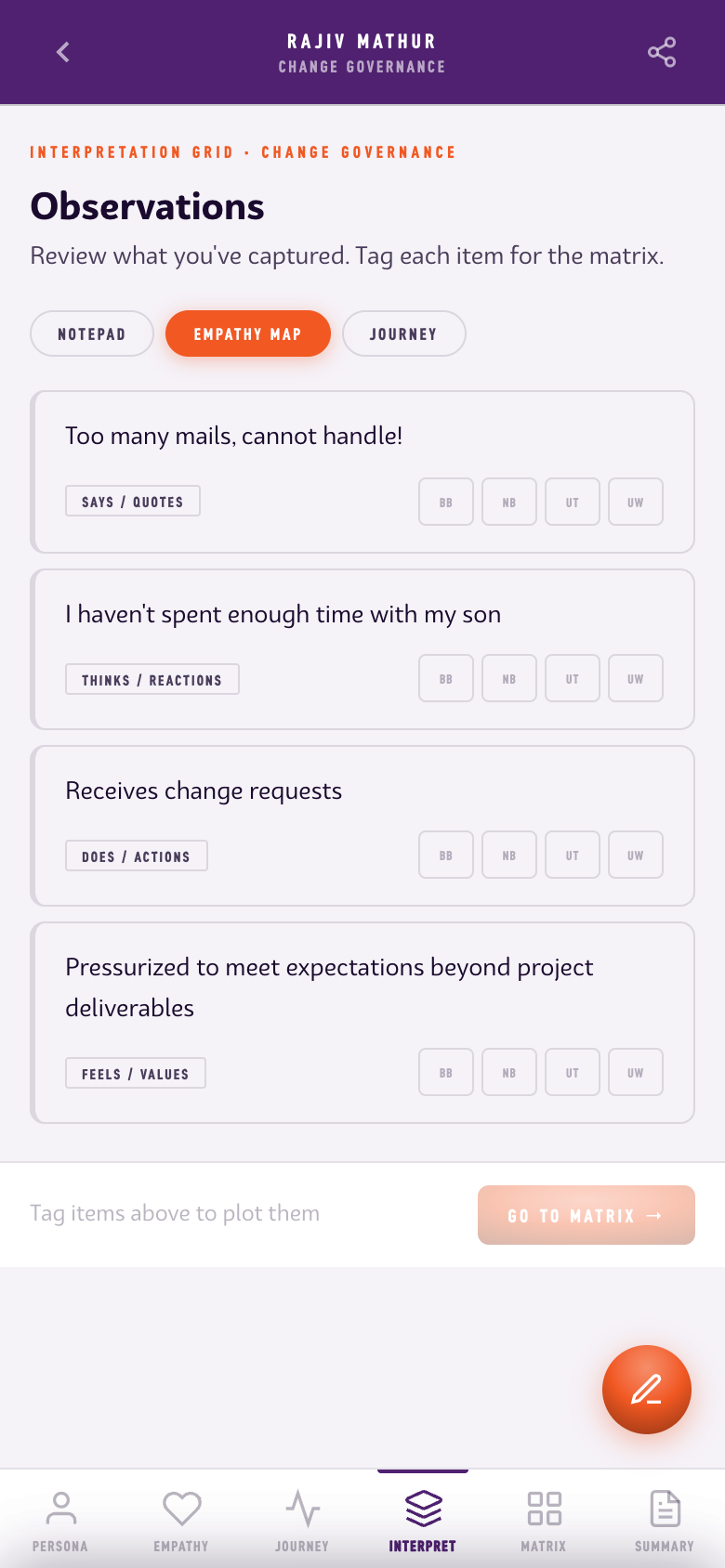
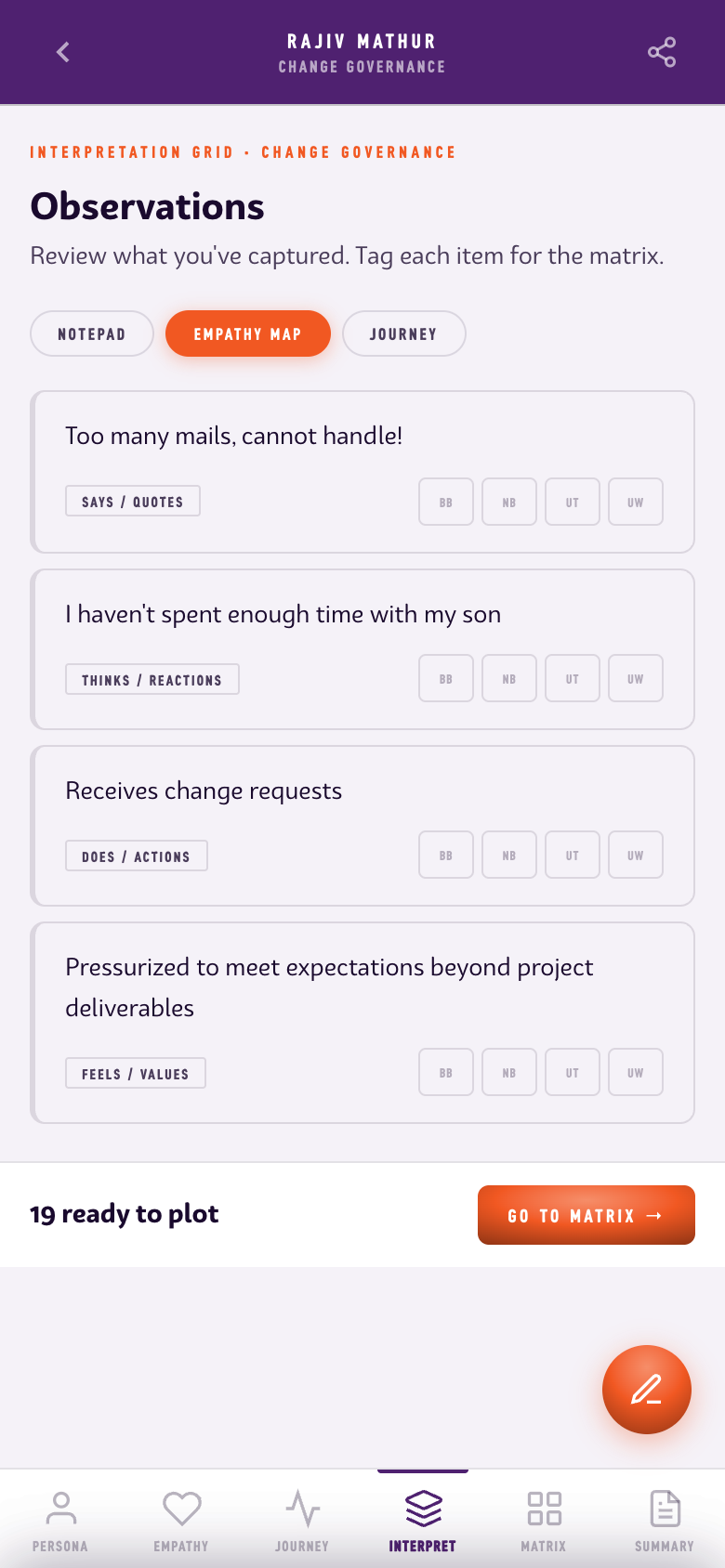
Pull observations from the notepad, the empathy map, and the journey into one place. Tag each one as a Big Bet, a No-Brainer, a Utility — or set it aside. The room stops debating which note belongs where, and starts arguing about what to do.
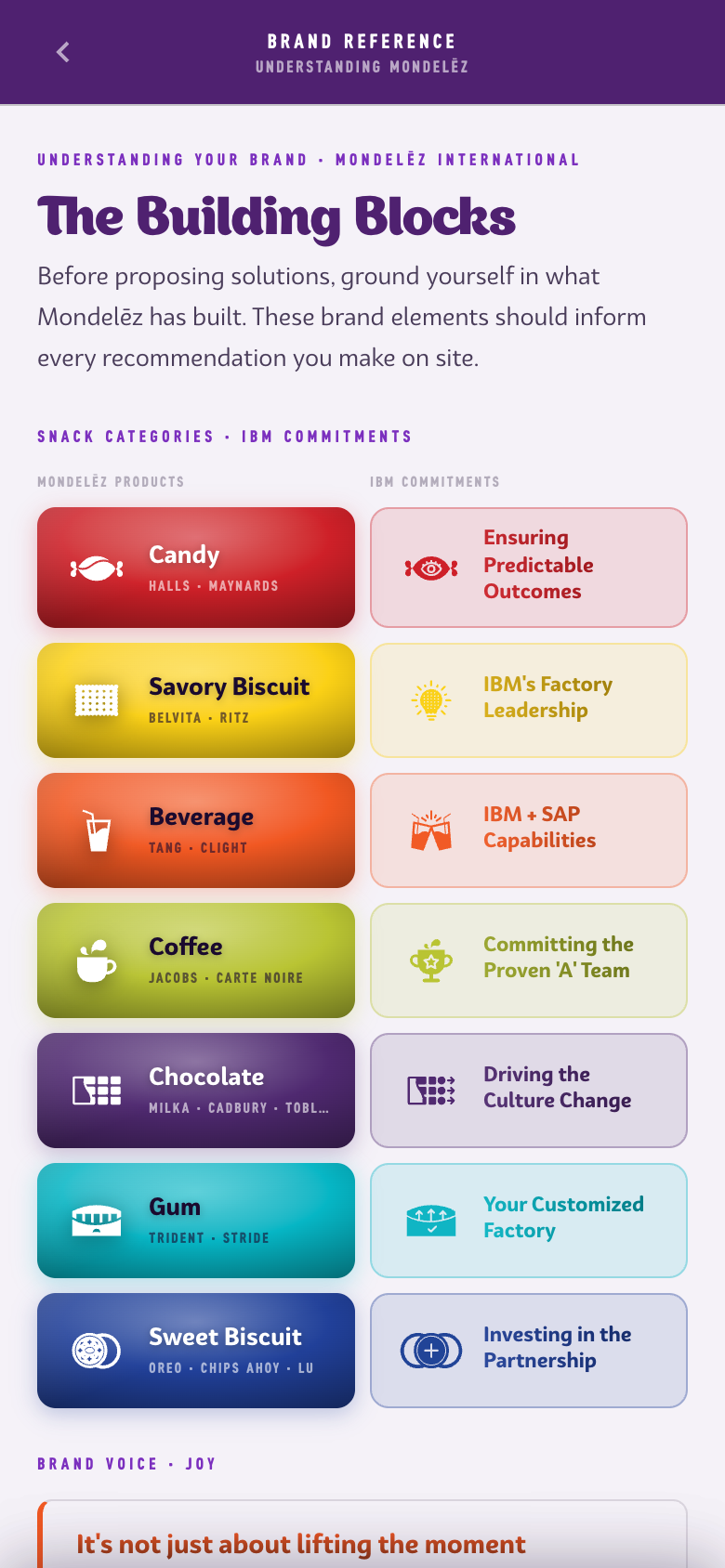
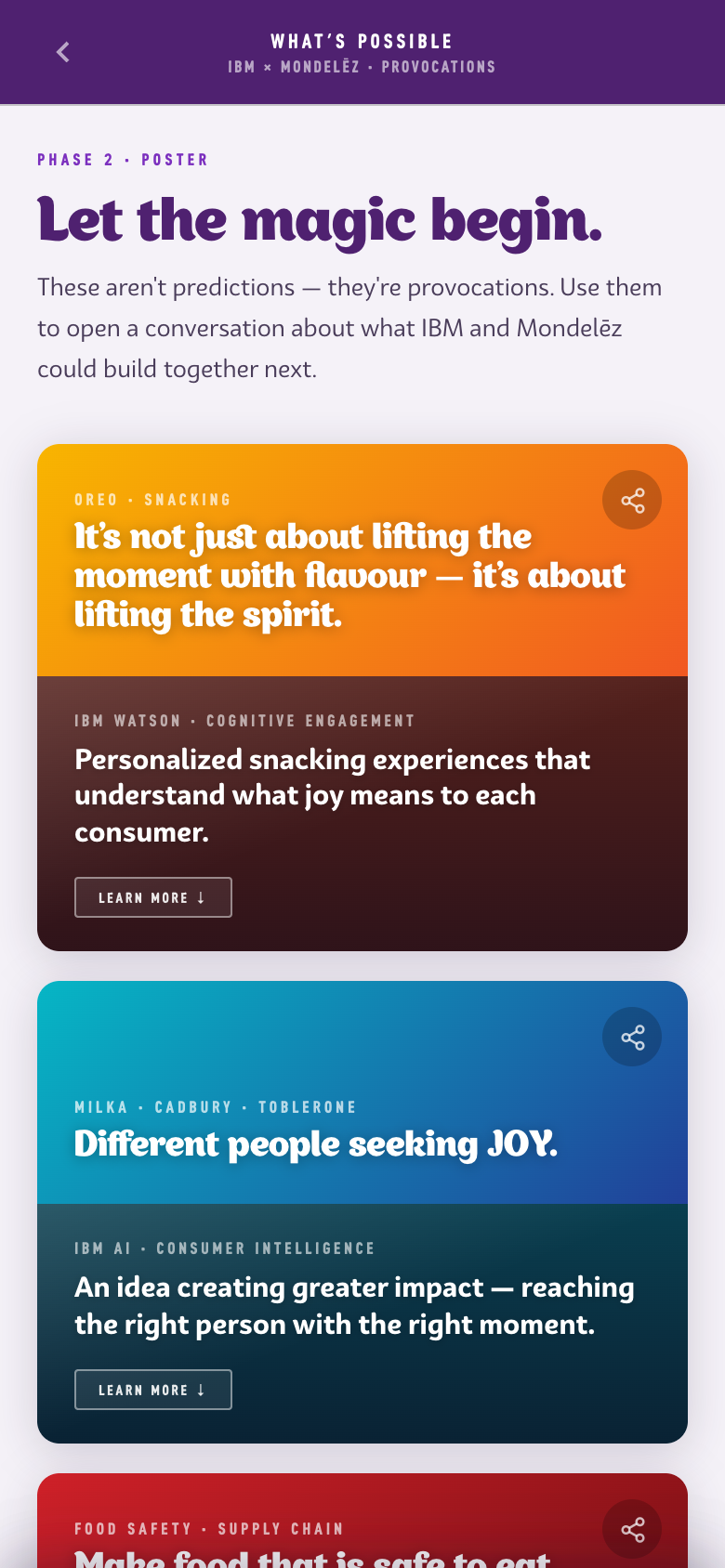
Two reference screens that grounded every conversation. The brand card spells out the seven categories and the seven IBM commitments. The inspiration deck offers four provocations — Cognitive Cocktails, Food Trust traceability, JOY-targeted personalisation — to keep the workshop ambitious before the matrix forces it pragmatic.
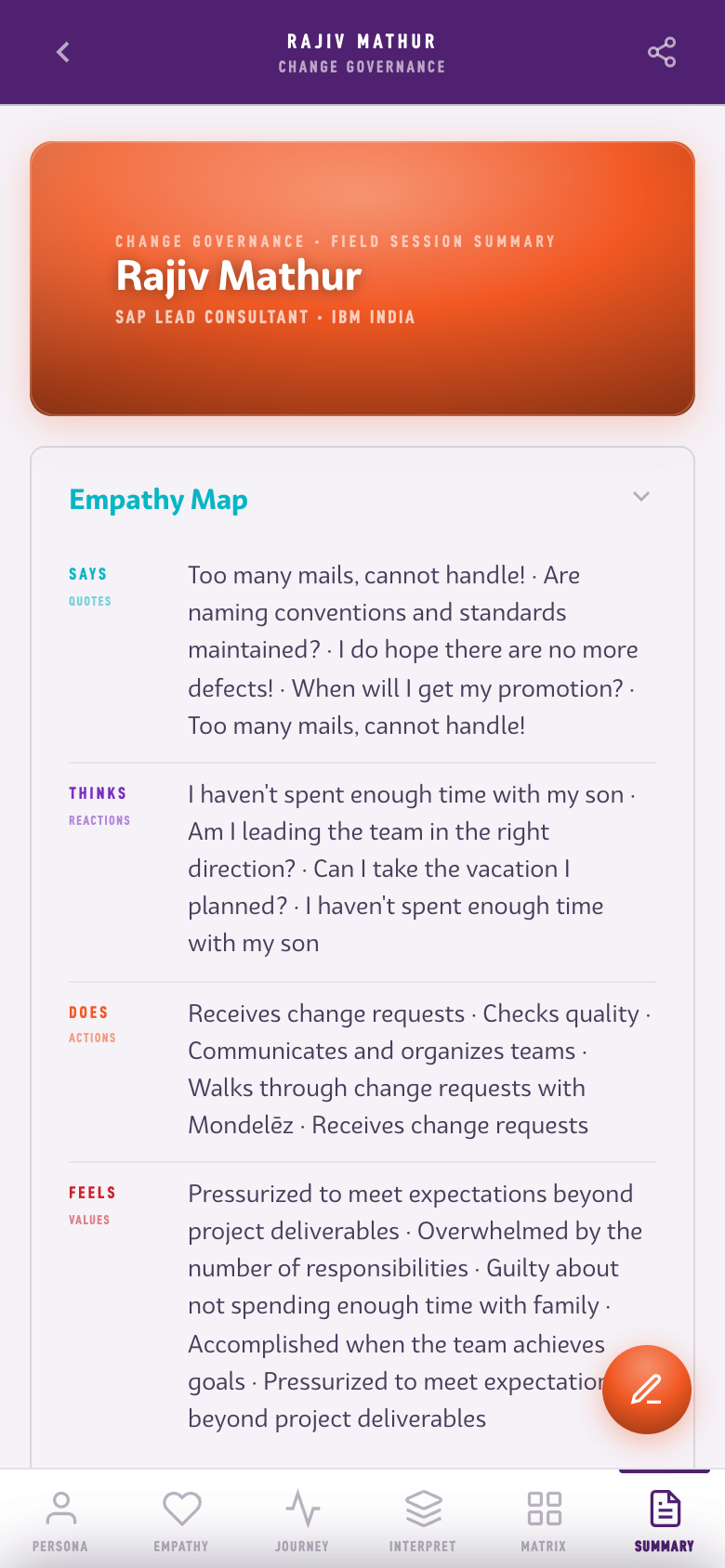
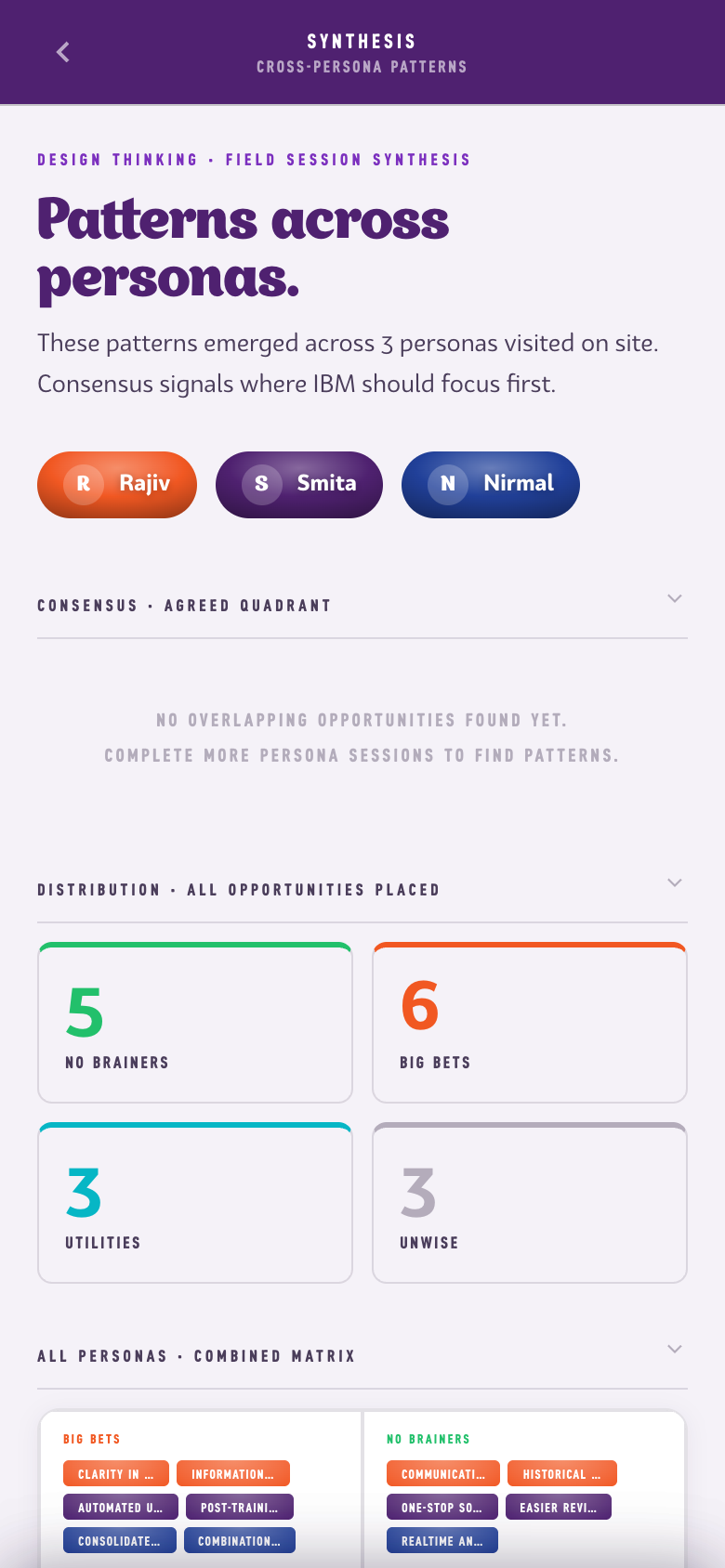
The persona summary collapses three tabs of work into one scrollable artefact — empathy quotes, journey opportunities, the placed matrix, all in one place. Across personas, the synthesis screen lifts the patterns: where Rajiv, Smita, and Nirmal converge, and where the IBM offer differs by role.